At Apple, my work centers on training foundation models and building the infrastructure around them: select and filter data, design training objectives, implement dataloaders, design tooling, integrate evaluation, baby-sit runs, conduct scaling studies.

The Design Space of Tri-Modal Masked Diffusion Models

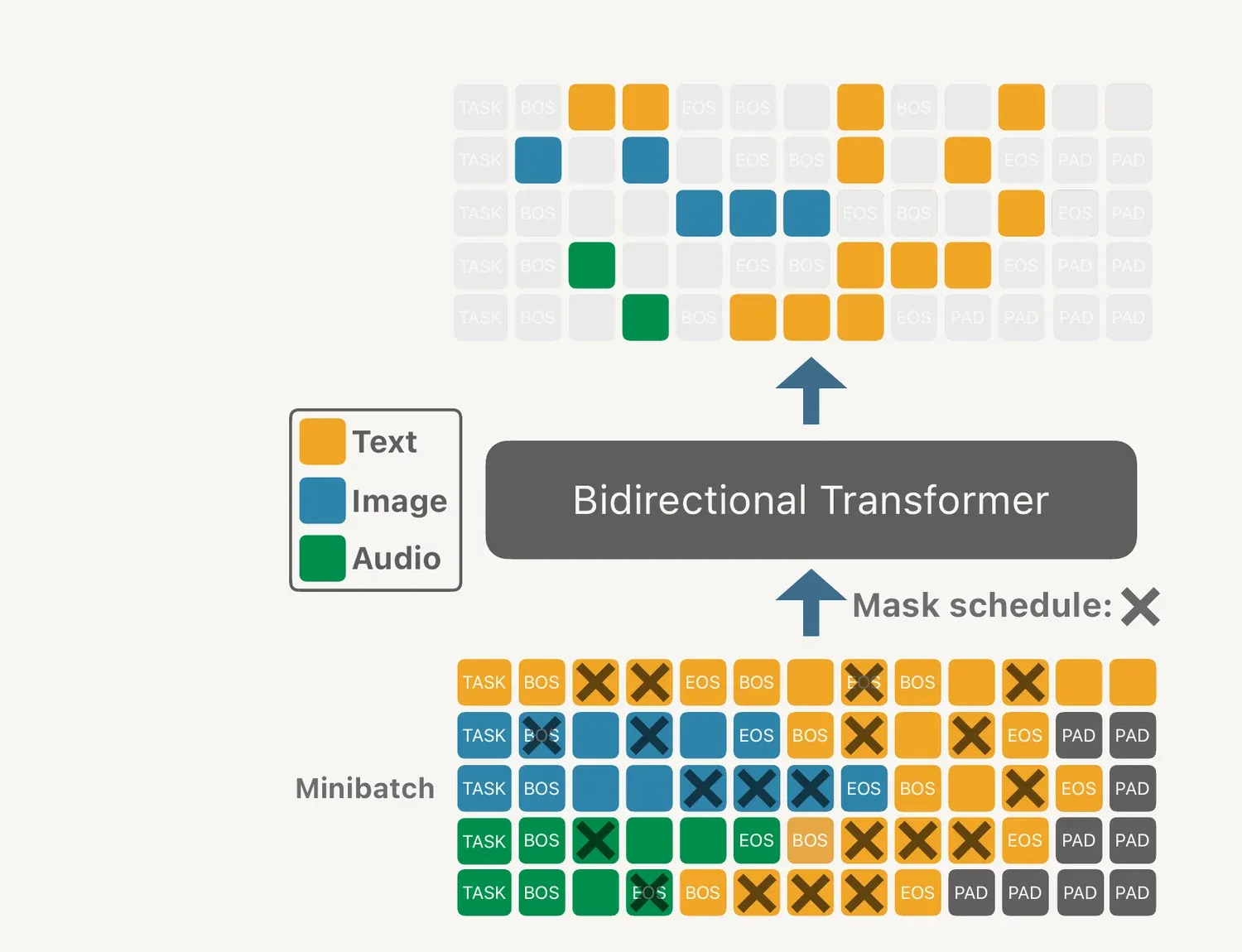
Tri-modal masked diffusion architecture: a bidirectional transformer over packed text, image and audio tokens

This effort trained 3B tri-modal masked-diffusion models on text, image, and audio at 6T-token scale. It covers the tri-modal design space: tokenization, noise schedules, loss weighting, modality balancing, zero-shot hyper-parameter transfer and scaling laws.

Paper
Removing Noise, not Finding Gold: Quality Filtering for Large-Scale Pretraining

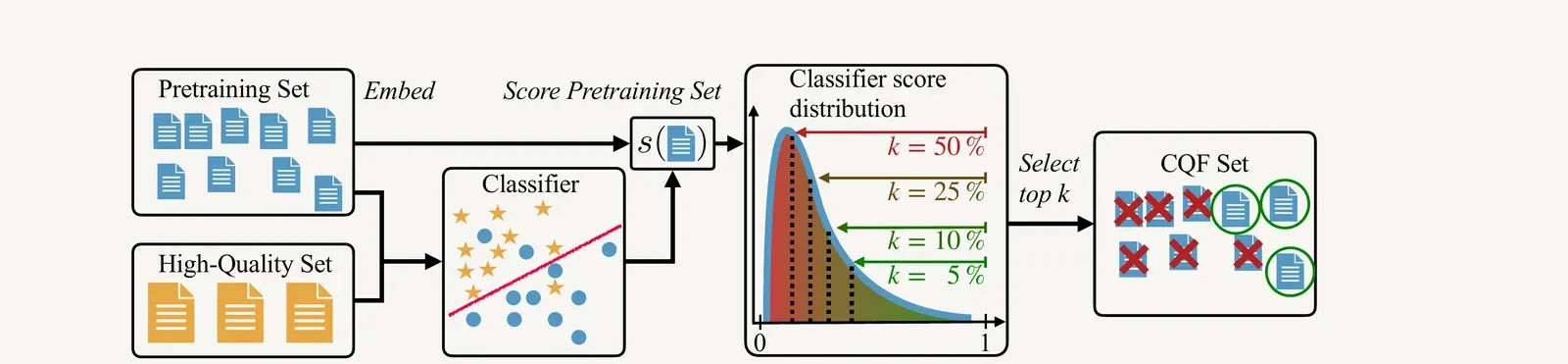
Classifier-based quality filtering pipeline: embed, score, and keep the top-k of the pretraining set

Quality filters are a standard part of pretraining pipelines, but what they actually buy is not obvious. Analyzed at scale, most of the gain comes from discarding the low-quality tail rather than from identifying rare high-value data, which has direct consequences for how filters should be built and tuned.

Paper

Scaling Laws for Optimal Data Mixtures

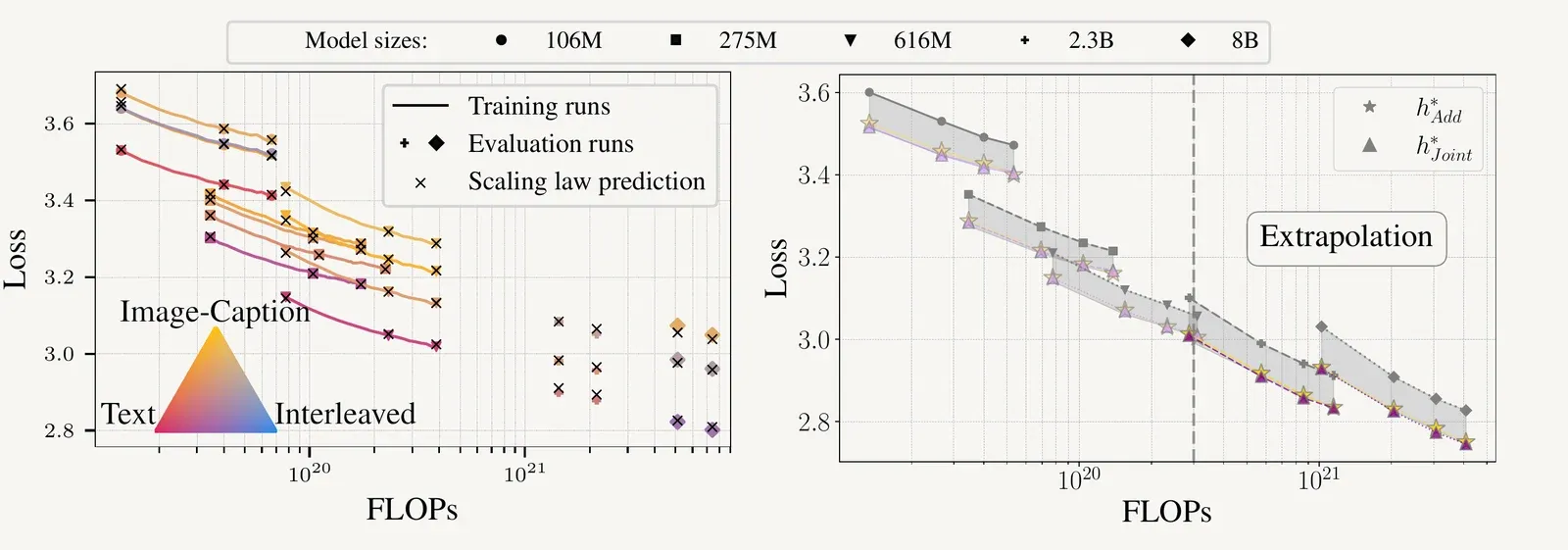
Scaling-law loss curves over training FLOPs with a data-mixture simplex (text, image-caption, interleaved)

Choosing how much of each data domain to train on is usually done by trial and error. Model performance as a function of mixture proportions follows predictable scaling laws, which can be fit on small runs and extrapolated to choose mixtures for larger training budgets.

Paper

Scaling Laws for Forgetting during Finetuning with Pretraining Data Injection

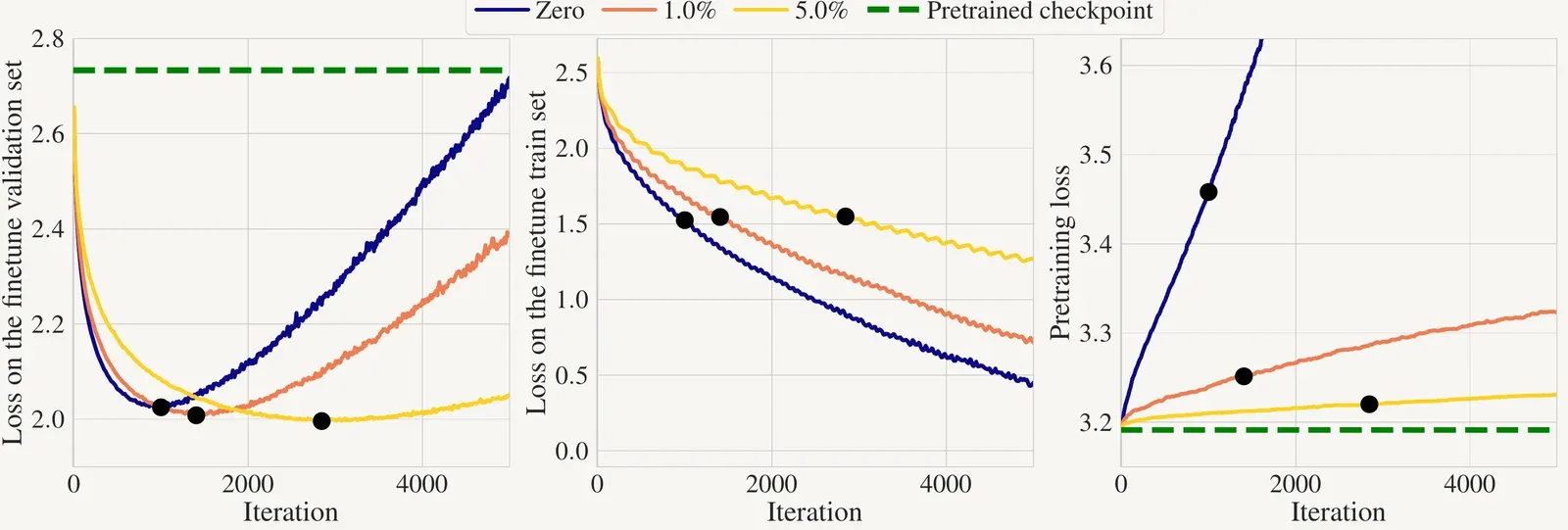
Finetune validation, train, and pretraining loss for 0%, 1% and 5% pretraining-data injection

Finetuning a pretrained model on new data tends to erase earlier capabilities. Mixing a small fraction of the original pretraining data back into finetuning follows a scaling law that quantifies the trade-off, so forgetting can be predicted and controlled rather than discovered after the fact.

Paper

My earlier and ongoing theoretical work studies how a constraint on the model, in particular its Lipschitz constant, ties together robustness, privacy, optimal transport, and geometry. The same constraint that certifies robustness also gives differential privacy without clipping, well-behaved neural distance fields, and stable explanations.

Follow the Energy, Find the Path: Riemannian Metrics from Energy-Based Models

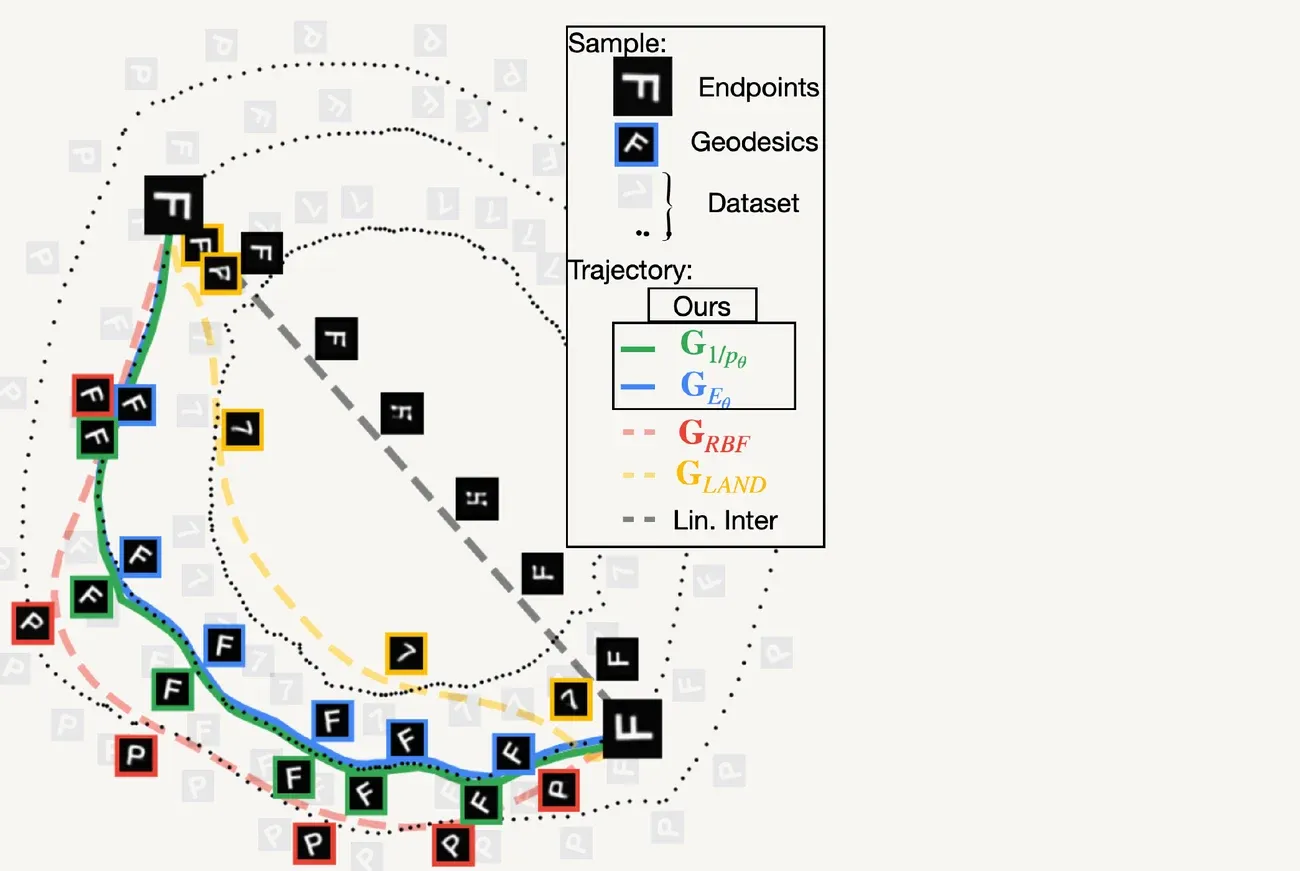
Geodesics following an energy-based Riemannian metric through the data manifold

An energy-based model assigns low energy to plausible data. This energy landscape becomes a Riemannian metric whose shortest paths stay in high-density regions, yielding data-aware distances and interpolations grounded in the learned distribution.

Paper

1-Lipschitz Neural Distance Fields

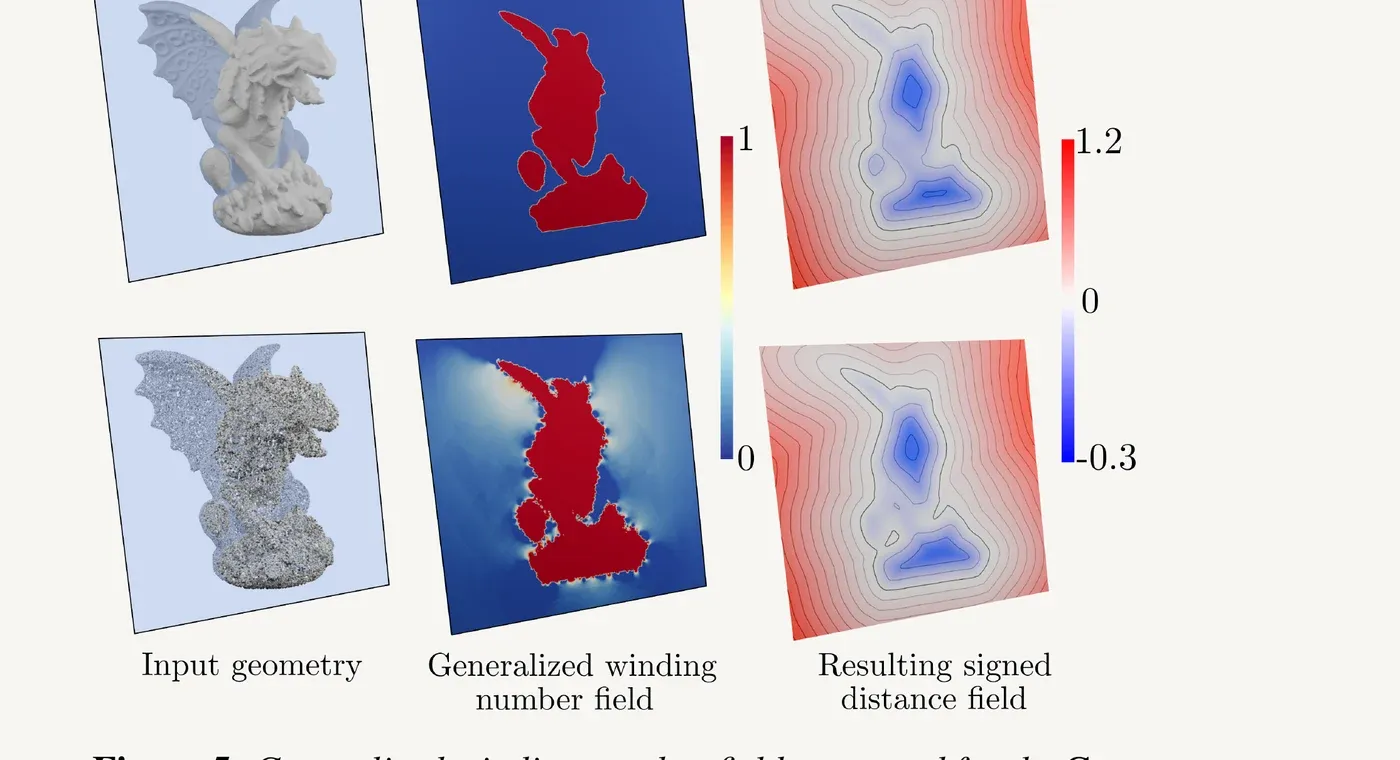
Gargoyle model: input geometry, generalized winding-number field, and the resulting signed distance field

A true signed distance function has unit gradient norm almost everywhere. Parameterizing the field with a 1-Lipschitz network obtains this property by construction rather than through a soft eikonal penalty, giving accurate and stable distance fields for shape representation. Best paper award at the Symposium on Geometry Processing (SGP) 2024.

Paper

DP-SGD Without Clipping: The Lipschitz Neural Network Way

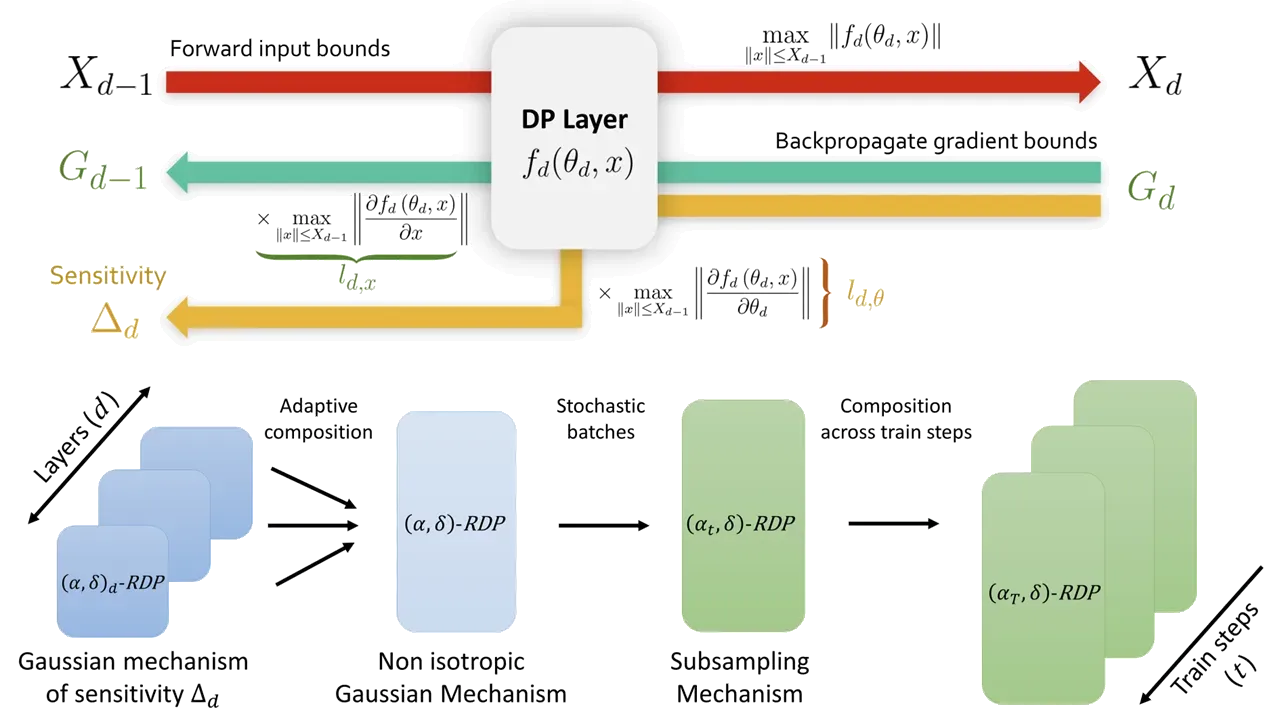
Private training with bounded-sensitivity Lipschitz layers

DP-SGD achieves differential privacy by clipping per-example gradients, which is expensive and hard to tune. Constraining the network to be Lipschitz gives an analytic bound on gradient sensitivity, so privacy guarantees follow without clipping, making private training simpler and more scalable.

Paper

Robust One-Class Classification with Signed Distance Functions

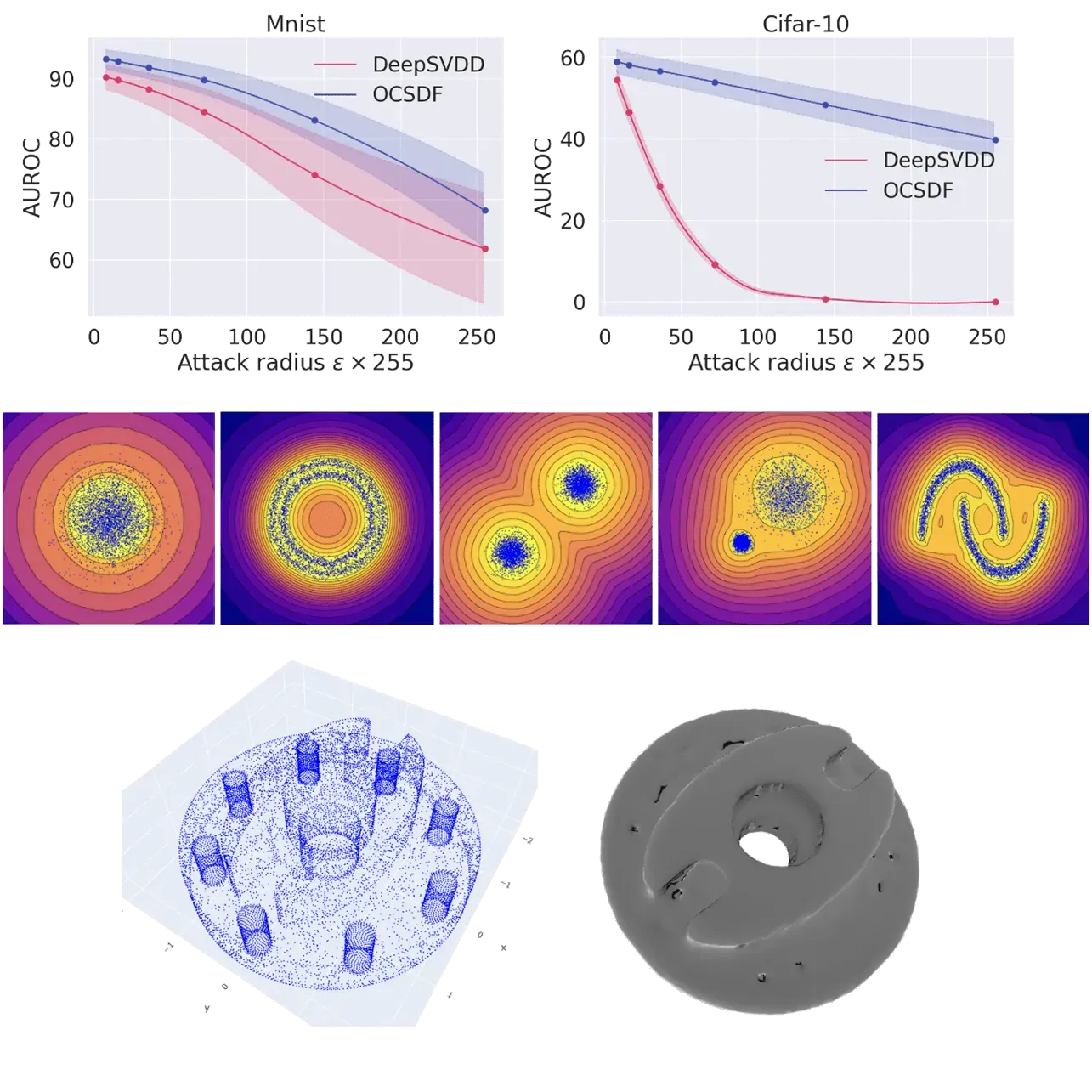
Signed distance function level sets separating in-distribution data

One-class classification asks whether a point belongs to the data distribution. Parameterizing a signed distance function with a 1-Lipschitz network gives a classifier whose margin is a certified distance to the boundary, which provides robustness guarantees and a geometric reading of what counts as in-distribution.

Paper

Pay Attention to Your Loss

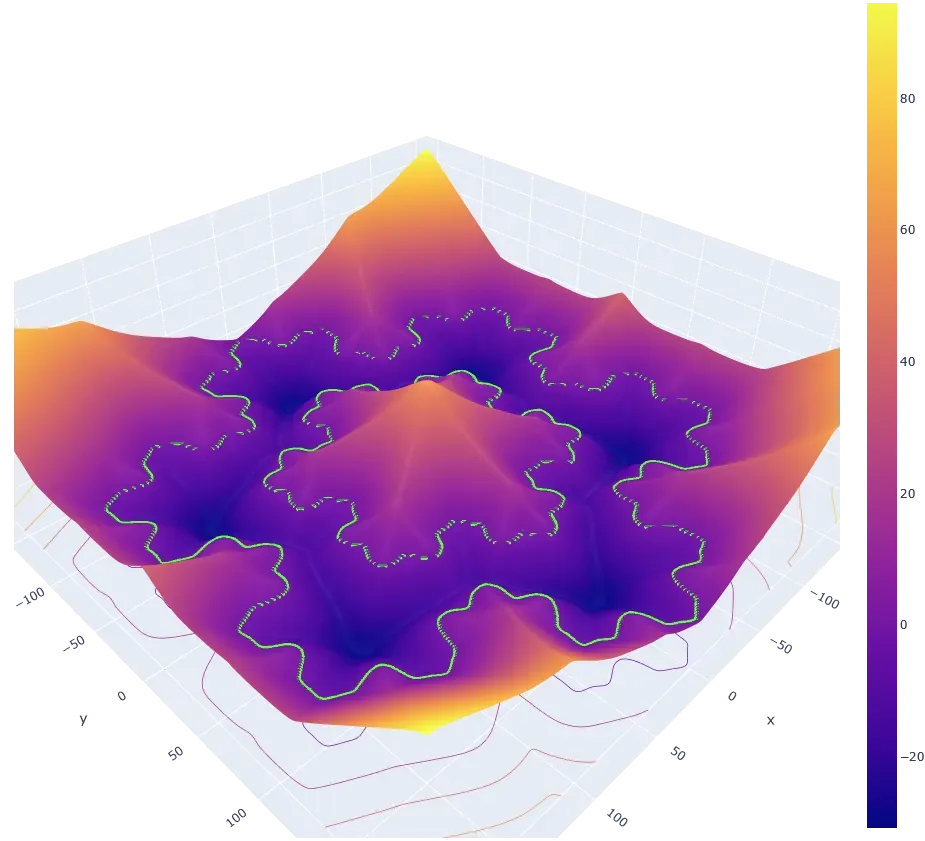
Von Koch fractal boundary illustrating a Lipschitz-constrained classifier

Lipschitz-constrained networks are often thought to trade accuracy for robustness. Much of this trade-off is an artifact of the loss function, and with the right loss these networks reach competitive accuracy while retaining certified robustness.

Paper